What is construction material recycling?
Construction material recycling includes all the operations required to separate, reduce, classify and recover materials generated by demolition, excavation and construction activities. In practice, construction material recycling aims to identify fractions that can still be used, process them until the required size or quality is achieved, and reduce disposal as waste whenever the material characteristics and intended use allow it to be recovered.
The stages of sorting, volume reduction, screening and aggregate recovery are closely connected: material recycling is not a single operation, but a sequence of processes that makes it possible to separate recoverable materials from fractions that need to undergo further treatment or be disposed of.
How construction and demolition materials are recycled
Material sorting and separation
The first stage consists of separating materials according to their type, size and potential destination. Proper sorting facilitates the recovery and recycling of materials and makes subsequent processing more efficient. At this stage, grapples make it possible to handle solid elements, construction waste and mixed fractions with greater control.
Crushing and volume reduction of aggregates
When the material is too large to be reused or screened, aggregate crushing makes it possible to reduce its size directly on site. This is a key stage in material recycling, as it allows concrete, bricks, rock, stone and other aggregates to be transformed into fractions that are easier to handle. For those who need to recycle materials from demolition work, the ability to crush them on site also reduces the need to transport large blocks and bulky waste.
Screening and material classification
After crushing, or directly on excavated material, screening makes it possible to separate fractions according to particle size. This process is useful for distinguishing fine material from coarser fractions and for organising recyclable materials more effectively. In construction waste recycling, more accurate separation makes it easier to identify what can be recovered and what requires further processing.
Recovery and reuse directly on site
The final objective is to obtain material that, when suitable for the intended application, can be reused within the same site or sent on for subsequent recovery processes. In this way, material recycling becomes part of site organisation rather than a separate activity managed exclusively off site.
Which construction materials can be recovered and processed?
In construction material recycling, the characteristics of the incoming material determine the type of processing required. Depending on the equipment used, materials that can be processed with CM equipment include concrete and demolition aggregates, bricks, natural stone, rock, marble, tiles, stony soil, gravel, dry or wet soil and mixed materials.
Not all recyclable materials require the same process: some need to be sorted first, others crushed, while others must be screened. The possibility of recycling materials depends on their composition, contamination level, required particle size and intended end use.
CM equipment for material recycling
Crusher buckets and crushers for aggregate recovery
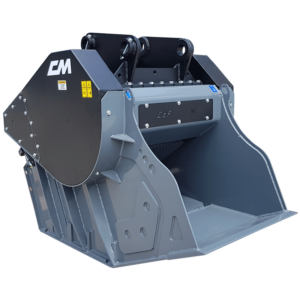
For volume reduction, CM offers the CBF crusher bucket, with adjustable output size from 20 to 140 mm, and the more compact CBF-L, with output size from 10 to 80 mm. For small demolition jobs, excavation work and natural stone processing, the CR electric jaw crusher is also available. These solutions bring material recycling directly to the point where aggregates are generated.
Screening buckets and systems for material separation
The CBR screening bucket is designed for sorting aggregates, stony soil and materials from demolition work, while the CDS disc screening bucket can process wet or dry materials and perform screening and crushing operations depending on the rotor kit installed. For processing larger volumes of material, MULTISCREEN RC provides a continuous mobile solution, allowing fine and coarse fractions to be separated directly on site using a configurable disc system.
Grapples for sorting and material handling
Material handling completes the process. The G Series sorting grapple, featuring continuous 360° hydraulic rotation, makes it possible to grip and sort solid materials of different shapes. It is a useful attachment for organising waste recycling from the earliest stages of work on site.
On-site aggregate recycling
Processing material directly on site helps reduce intermediate handling operations and organise the different stages of work more efficiently. In material recycling, sorting, crushing and screening directly on site makes it possible to reduce the volume of aggregates to be transported, separate potentially reusable fractions more easily and maintain greater control over the entire process. This approach is particularly effective when recovery is planned from the very beginning of the demolition process: properly separating materials, reducing their size and classifying them according to their characteristics helps avoid unnecessary processing and makes it easier to identify fractions suitable for recovery. In this way, waste and recycling become part of a single workflow, while material recycling is integrated directly into site management and adapted to the quantities to be processed, the type of aggregate and the actual requirements of the site.
Choose CM equipment for material recycling
There is no single configuration suitable for every material recycling operation. The choice depends on the type of aggregate, the initial and required final particle size, the presence of soil or mixed fractions, the quantity to be processed and the carrier machine available. For this reason, CM offers solutions dedicated to each stage of the process, from sorting and crushing to screening.
If you would like to find out which equipment is best suited to your material recovery and recycling project, contact CM Srl: our team can assess the application, the material to be processed and the carrier machine in order to identify the most suitable solution.