
 Products



 Riciclaggio
 Cave e miniere
 Gallerie
 Edilizia


Applications and Fields of Use
On-site crushing has become an increasingly strategic phase to reduce logistics costs, minimize waste disposal, and reuse aggregates in new construction works.
CM equipment allows concrete, bricks, asphalt, rocks, as well as granite and marble scraps, to be transformed directly on site into reusable material — with immediate benefits in terms of time and budget. In urban construction sites, for example, on-site crushing reduces trips to external plants and speeds up project completion. In road construction, it allows the production of sub-base layers and well-graded aggregates ready for immediate use. In quarries, it allows pre-crushing and reconditioning of natural stones, avoiding machine downtime.
A key aspect is recycling: the crushed material can re-enter the supply chain as aggregate for non-structural concrete, embankments, fillings, and drainage layers.
Working with on-site crushing machines — whether crusher buckets mounted on excavators or mobile electric crushers — reduces the site’s environmental footprint, improves safety (thanks to fewer handling operations), and ensures full traceability of materials. For companies and public administrations, it’s a real competitive advantage: greater control, less dependence on third parties, and faster adaptation to project changes.
Types of Crushing and Jaw Technologies
Jaw technology is at the heart of CM equipment. The principle is simple yet effective: two crushing plates generate progressive compression that reduces material by squeezing. This solution is robust, handles dirty materials or light reinforcements well, and ensures consistent particle sizes.
In material processing, three crushing stages are generally distinguished:
- Primary crushing, which receives large pieces from demolition or excavation and reduces them to medium-fine sizes.
- Secondary crushing, which refines the output to achieve grading curves suitable for road foundations and fillings.
- Tertiary crushing, when required, further calibrates the material to meet tighter specifications.
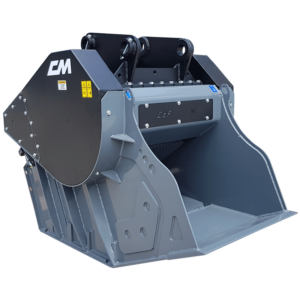
CM crusher buckets and the mobile electric jaw crusher provide maximum operational flexibility, covering all crushing stages — primary, secondary, and even tertiary.
Thanks to quick jaw gap adjustment, the operator can switch in a few minutes from larger to finer output size: the CBF series crusher buckets reach down to a minimum of 20 mm, while the electric crusher and compact crusher buckets (CBF-L series) can achieve 10 mm, ensuring precise results without long downtimes.
When compared with other technological families, the advantages are clear: cone crushers also work by compression but are typically used for harder materials and steady feed rates; impact crushers rely on shock fracture and perform best with friable materials.
CM’s choice to focus on jaw systems for both crusher buckets and mobile electric crushers offers the ideal balance between strength, mechanical simplicity, low maintenance, and high-quality crushed material for most on-site applications.
In this context, a full crushing plant on wheels or tracks may also be used; however, the operational agility of CM equipment often makes the mobilization of a complete plant unnecessary. With a crusher bucket on the excavator, you can work wherever and whenever needed, without complex machine transfers or dedicated layouts.
When higher volumes and continuous processing are required, an electric inert material crushing plant provides an orderly, quiet, and efficient cycle with low energy consumption and precise control over the output gradation.
How to Choose the Right Crusher Bucket
The choice mainly depends on the carrier machine, the material to be processed, production goals, and the desired output size. The weight-to-capacity ratio is crucial: the bucket must “match” the excavator or skid steer, respecting the permitted loads and ensuring stability. An excavator with adequate hydraulic power guarantees productivity and continuous operation. For this reason, CM Srl offers a wide range of models suitable for skid steers, backhoe loaders, wheel loaders, and heavy excavators.
The nature of the material determines the initial jaw opening and output adjustment:
- Reinforced concrete requires tolerance to foreign objects and easy discharge.
- Asphalt benefits from settings that limit the generation of fines.
- Hard rock demands high crushing energy.
Here, the 18% manganese crushing plates come into play: they resist wear and maintain an active profile for longer, extending maintenance intervals.
The HARDOX structure, on the other hand, ensures robustness and overall durability, reducing deformation and fatigue even under the toughest working conditions.
Another important factor is operational efficiency: a correctly sized crusher bucket reduces idle cycles, optimizes loading and unloading times, and maximizes hourly output.
In scenarios with variable volumes or intermittent operations, an excavator-mounted crusher bucket is unbeatable for its speed and flexibility.
When continuous production is required, electric crushing plants for inert materials allow for extended shifts with steady power consumption and the option to integrate screens or conveyor belts for material separation.
Maintenance, Costs, and Durability
Productivity continuity starts with operational simplicity.
The centralized greasing system minimizes errors and simplifies daily maintenance.
The high-manganese content plates provide exceptional resistance to fatigue and abrasion, ensuring uniform and predictable wear.
The quick output size adjustment reduces downtime and allows the operator to adapt to different materials without complex procedures.
From a cost perspective, optimization relies on three key factors: energy, wear, and logistics.
With a crusher bucket, you eliminate many external handling operations, reduce landfill disposal, and lower aggregate purchasing costs.
With a mobile electric crusher, you improve the kWh/ton ratio and obtain a more homogeneous output, often avoiding the need for third-party screening.
CM’s modular design and ready availability of spare parts make scheduled maintenance straightforward, with short and easily planned service stops.
Get in Touch for Tailored Crushing Solutions
Every job site comes with its own challenges and goals. At CM Srl, we evaluate your carrier machine, material type, desired output size, and logistical setup to identify the most effective solution — whether it’s a crusher bucket, a mobile electric crusher, or a smart combination of both. Our goal: maximum efficiency, consistent crushed quality, and full cost control.
Reach out to us to define the right settings, expected productivity, and any additional equipment such as screens, conveyors, or separation systems.
Together, we’ll turn your crushing process into a real advantage on site.
