
 Products



Recycling cementitious material is an increasingly important topic for companies that produce concrete products and precast concrete elements. Within production plants, processing waste, offcuts, broken pieces, non-compliant products and returns can accumulate over time. These materials cannot be placed on the market but, if properly treated, can be transformed from a management cost into a recoverable resource.
In many production facilities, these residues are still considered a burden to be moved, stored and sent off-site. Yet a structured waste recovery process makes it possible to address the issue at its source: the material is reduced in volume, transformed into more manageable particle sizes and potentially reused in new applications, reducing waste and logistics costs. For companies that produce precast elements, the point is not only to “dispose of them better”, but to rethink the management of concrete and cement production waste from a more efficient and circular perspective.
What is meant by cement recycling and cementitious material recovery?
This expression refers to all the operations aimed at recovering cementitious materials, concrete and products that can no longer be used in their original form. The process may involve material from demolitions, but also residues generated directly during industrial production.
In plants that manufacture precast concrete elements, recovery can involve many different types of residues: elements broken during handling, defective products, pieces rejected during quality control, offcuts from subsequent processing, products damaged during transport or returns that can no longer be reused. The principle is simple: a material that can no longer be used as a finished product can be subjected to crushing to obtain a smaller and more manageable particle size. In this way, the company can assess the reuse of the material according to its needs, or simplify the subsequent transport, selection and treatment stages.
Why is the recovery of cementitious waste increasingly important?
Production waste management is a concrete issue for many companies in the construction and precast concrete sectors. When quantities increase, unused cement takes up space, requires internal handling and generates costs that affect the overall efficiency of the plant. Recovering cementitious material first of all makes it possible to reduce the volume of residues to be managed. A broken or non-compliant precast product can be very bulky; once crushed, it becomes easier to store, handle and transport. This helps optimize storage areas and reduce the number of operations required to free up production space.
There is also a broader benefit linked to the possibility of enhancing the value of materials that would otherwise be treated exclusively as waste. Crushing makes it possible to obtain more regular and homogeneous fractions, opening the way to subsequent stages of reuse, screening or destination to compatible applications. Recycling waste from precast concrete products should therefore not be seen only as a volume reduction activity, but as a strategic step towards more modern production cycle management.
This is also connected to sustainability. Cement and concrete production is closely linked to the consumption of raw materials and the management of high-density materials. For this reason, every action that allows waste to be recovered and reduces the need for new external disposal contributes to improving the environmental efficiency of the system. For producers of precast elements, this means encouraging an industrial culture closer to the principles of the circular economy, where material is evaluated not only based on its first use, but also on the possibility of being reintroduced, transformed or enhanced in a subsequent cycle.
Difference between recovery within the plant and demolition crushing
It is useful to distinguish the recovery of industrial waste from rubble crushing, which is more typical of demolitions, renovations and construction sites. In these cases, materials can be very different from one another: bricks, concrete, plaster, mixed residues and non-homogeneous fragments often require more complex selection before they can be processed. In precast production plants, on the other hand, waste can be more easily identified and linked to a precise production chain. A company knows what type of product has been rejected, what materials it is made of and at which stage the non-conformity occurred. This knowledge at the source makes it possible to design a more targeted recovery system.
The difference is not only in the origin of the waste, but in the objective. On a construction site, the goal is often to reduce rubble and demolition materials to simplify site management or recover aggregates. In a plant, however, the treatment of waste can become an integral part of production efficiency and industrial planning.
Precast concrete waste: which materials can be recovered?
Recovery does not only involve demolition rubble or mixed materials from construction sites. In the specific case of product manufacturers, the field of application is even more targeted and closely connected to internal production.
Precast concrete waste can be generated at different stages: during casting, curing, handling, storage or transport. Blocks, kerbs, manholes, slabs, panels, modular elements and other products that do not meet the required standards can be recovered through a mechanical reduction process. The same applies to breakages, returns and non-compliant products. A damaged element is not necessarily worthless as a material: if it can no longer be sold, it can still enter a recovery cycle. Crushing makes it possible to process these accumulations and prevent them from remaining in storage for long periods without an efficient destination. Some production processes also generate offcuts and irregularly sized residues, which are difficult to manage and not suitable for orderly handling. Reducing them to a more uniform particle size simplifies the following operations and helps make the internal waste management flow more efficient.
Technologies and practices for recovering cementitious material
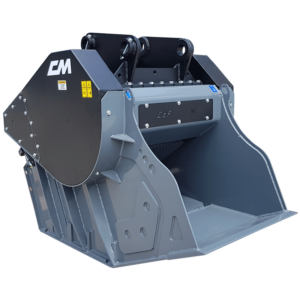
The recovery of cementitious residues can be carried out using different solutions. On construction sites, for example, equipment mounted on operating machines is often used to process material directly on site. Some examples are the CBF crusher bucket and the CBF-L crusher bucket, designed for volume reduction and aggregate processing in dynamic operating contexts.
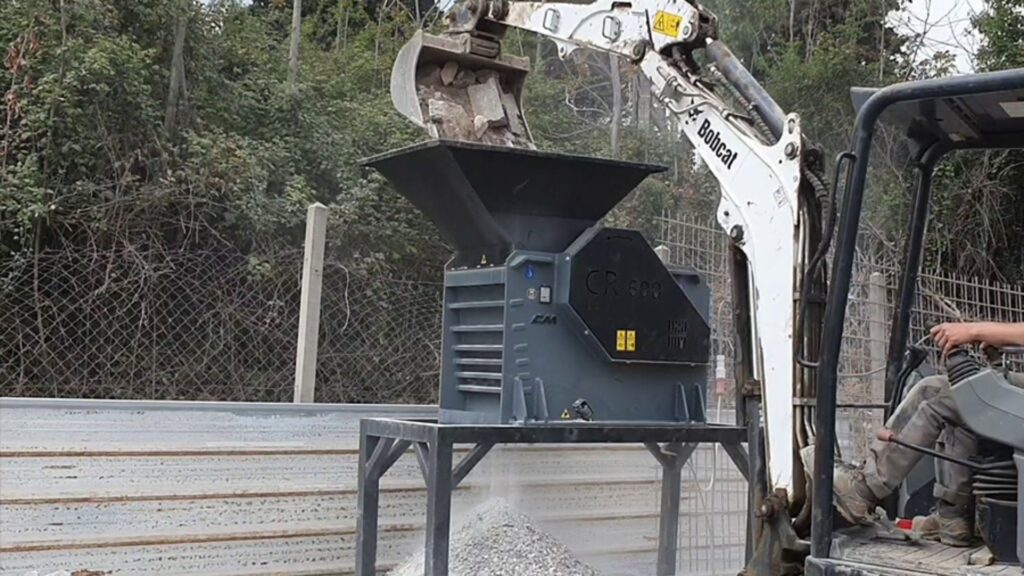
In production plants, on the other hand, it may be more advantageous to adopt a dedicated solution, such as the CR electric jaw crusher by CM Srl, designed to work continuously or repeatedly on waste generated internally. An internal cementitious waste recycling system makes it possible to organize the flow with greater continuity: waste material is collected, loaded, crushed and managed without having to depend on external operations at every stage. This approach is particularly interesting for companies that regularly produce cementitious products and want to integrate recovery into their industrial logic. Instead of waiting for large quantities of material to accumulate for disposal, it is possible to set up a more orderly process, distributed over time and consistent with production rhythms.
CR 600: the electric jaw crusher for precast concrete products and production waste
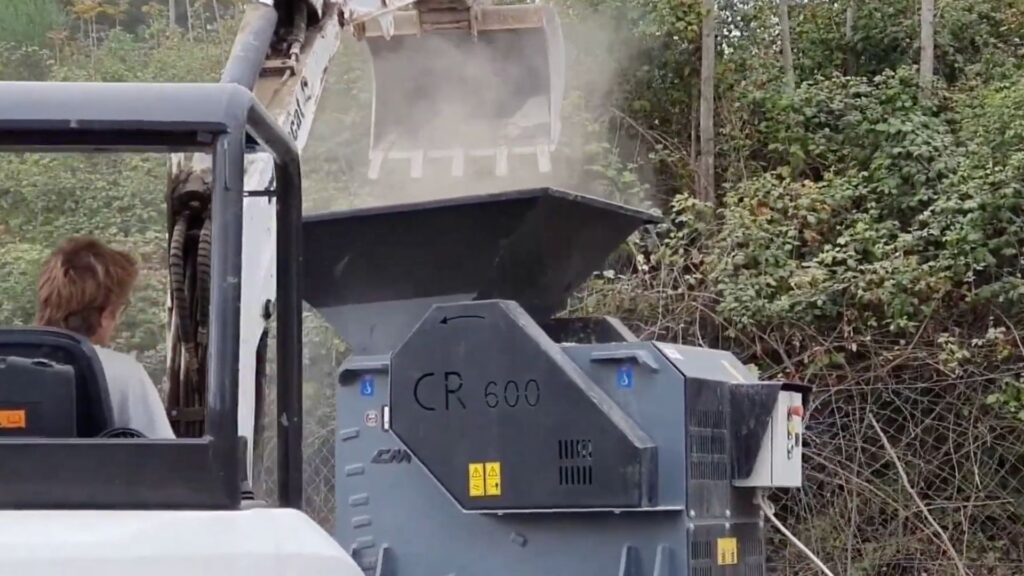
For the recovery of production waste, the CR electric jaw crusher is a particularly suitable solution for companies that need to process precast concrete products, offcuts, breakages, returns and non-compliant products. It is a compact yet robust crusher, designed to reduce cementitious materials and aggregates into more manageable particle sizes, simplifying handling, storage and the subsequent recovery stages.
The CR 600 model has a 600×300 mm crushing inlet, making it suitable for processing larger waste compared to the CR 400. The material is reduced through the movement of the jaws, with an adjustable output size from 10 to 80 mm, allowing the process to be adapted to the specific needs of the plant and the intended type of recovery. From a construction point of view, the crusher is designed to work on hard and abrasive materials: the crushing plates are made of 18% manganese cast steel, while the liners and crushing chamber are made of HARDOX 450. These features make it a reliable solution for companies that need to continuously manage cementitious waste, broken precast products and inert material generated by production.
The advantages of having a CR 600 crusher in the company
Integrating a CR 600 crusher into the precast waste recovery process provides very concrete benefits from an operational and organizational point of view. The first concerns the volume reduction of residues: broken products, oversized pieces and bulky waste are transformed into material that is easier to store, handle and manage. A second advantage is greater autonomy in waste management. When there is a constant flow of cementitious material to be recovered, the company can process it progressively, without waiting for large quantities to accumulate before sending them off-site. This helps keep storage areas tidier and reduces the impact of waste on the organization of the plant.
The adjustable output particle size also makes it possible to adapt the treatment according to internal objectives: from simple volume reduction to the preparation of material intended for subsequent processing or granulometric selection. The possibility of adding conveyors, screens and a magnetic separator further increases the level of system customization and makes the CR 600 even more suitable for handling materials containing reinforcement, such as reinforced concrete, or for obtaining a more orderly flow of crushed material.
A further advantage for companies in the sector is the possibility of integrating the crusher directly into the production cycle, turning it into an internal solution for recovering cementitious waste. The CR 600 is supplied with a hopper and support as standard and can be configured with customized solutions according to the production layout, so that it can be installed at the most functional point of the plant, close to the area where the waste is generated. Depending on the needs, it can be combined with a conveyor belt, a magnetic separator for reinforcement steel, a one- or two-stage vibrating screen, as well as custom-designed hoppers and supports. In this way, the crusher is not an isolated element, but can become the core of a line dedicated to waste treatment.
To evaluate the configuration best suited to your needs and receive more information on the most suitable solution for recovering the cementitious waste generated by your production, contact CM Srl with no obligation!
Frequently asked questions about cementitious material recovery
Precast concrete waste, production offcuts, broken pieces, non-compliant products, returns and other cementitious residues generated within the production cycle can be processed.
Yes. An internal recovery process can help reduce bulk, handling operations and costs related to storage and external disposal of materials. In addition, it allows the crushed material to be recovered and reused more quickly within the company’s production cycle.
Yes. Rubble crushing often involves mixed materials from demolition, while the recovery of precast waste concerns more homogeneous residues linked to a specific production process.