
 Products

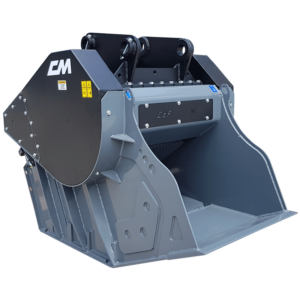


When it comes to excavator attachments, the term grading bucket is often used generically to describe a bucket designed for material selection. What seems like a simple definition actually encompasses very different technical solutions, with distinct performance levels, limitations, and fields of application. Understanding what a grading bucket truly is, what its real operational capabilities are, and when it is more appropriate to use a screening bucket allows you to make an informed decision, improve on-site efficiency, and optimize the overall work cycle.
What Is a Grading Bucket?
A traditional grading bucket is a passive attachment featuring a structure with fixed grid bars. The spacing between the bars determines the size of the material that is retained or allowed to pass during excavation and handling operations. Material selection occurs solely through the movement of the excavator and the operator’s action. There are no mechanical screening systems or hydraulic components actively working the material. Grading buckets for mini excavators and excavators are designed to meet simple needs, such as soil cleaning or the rough separation of stones and aggregates during excavation.
When a Traditional Grading Bucket Is the Right Choice
In certain operational contexts, an excavator grading bucket is an adequate and functional solution. It is particularly suitable when operations are occasional and when material selection and screening quality are not central stages of the production process. It is mainly used on small job sites or for cleaning operations, where the primary objective is to quickly separate coarse material without the need for precise size control. In these cases, structural simplicity translates into robustness, ease of use, and reduced operating costs.
The Structural Limits of a Grading Bucket for Excavators
However, when operating conditions become more complex, the limitations of traditional grading buckets for mini excavators and excavators become evident. Screening is not a controlled process, and the quality of the result largely depends on the operator’s skill and the nature of the material. With wet, clayey, or mixed soils, material tends to compact between the bars, drastically reducing selection efficiency. Productivity also remains limited when material volumes increase or when continuous operation is required. In all situations where material selection is no longer a secondary operation but becomes a structured phase of the work cycle, more advanced technology is required.
From Passive Selection to Active Screening
Screening buckets are designed to overcome these limitations, transforming material selection into an active, controllable, and repeatable process. Unlike traditional grading buckets, they do not simply “let material pass” but continuously process it, ensuring consistent quality results.
Active screening allows you to:
- Increase hourly productivity
- Reduce operator dependency
- Process difficult or wet materials
- Achieve uniform particle size
- Adapt to different applications and materials
Within the CM range, this approach is implemented in two distinct solutions designed to meet different operational needs: CBR and CDS.
CBR Screening Bucket: Precision and Control in Material Selection
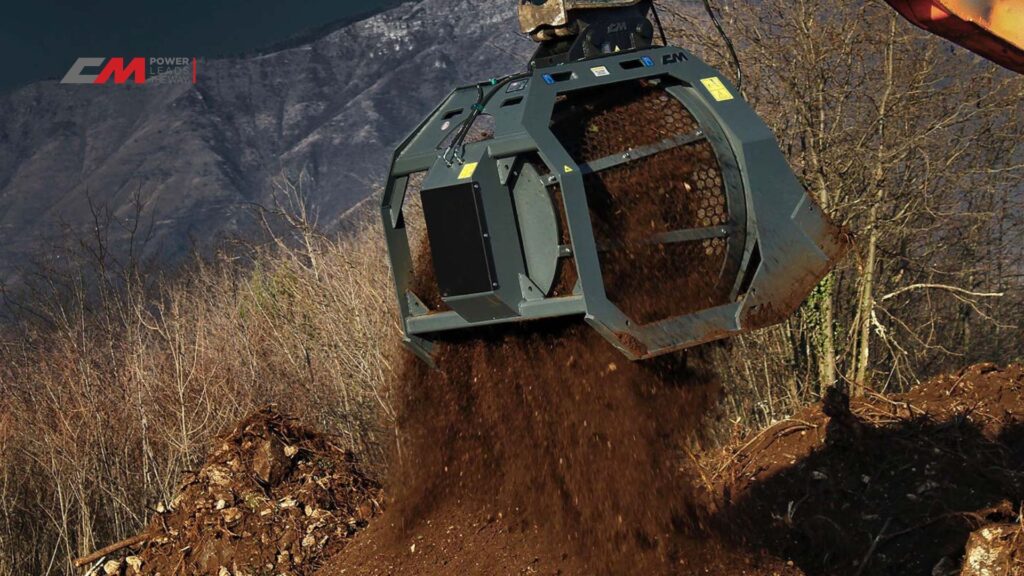
The CBR screening bucket features a basket with interchangeable grid screens, designed for the controlled selection of materials such as stony soils, demolition aggregates, and excavation materials.
At the heart of the system is a bi-rotational basket, ensuring continuous and uniform screening. The option to select different grid sizes allows the machine to be adapted to the desired particle size while maintaining consistent material quality even with large volumes.
CBR is particularly suitable when:
- Screening must be precise and repeatable
- The material is mainly dry or mixed
- Selection is an integral part of the production cycle
- Operational continuity is required
- Fine material must be enhanced for reuse or resale
It is widely used in construction, recycling, and quarrying, where material selection cannot be left to approximate solutions.
CDS Screening Bucket: Maximum Productivity with Complex Materials
The CDS screening bucket has been developed to deliver high performance even under the most demanding conditions. Its rotating disc system enables efficient processing of wet, damp, or highly heterogeneous materials, reducing clogging risks and maintaining constant productivity over time.
A key strength of the CDS is its operational versatility. Thanks to different rotor kits, the machine can be configured not only for screening but also for medium-light shredding and crushing operations. This makes it an ideal solution for recycling, green maintenance, and the management of complex materials in urban and industrial environments.
CDS is the most suitable choice when:
- The material is wet or damp
- High hourly output is required
- The job site operates continuously
- A flexible, multifunctional solution is needed
Grading Bucket vs. Screening Bucket: A Different Approach
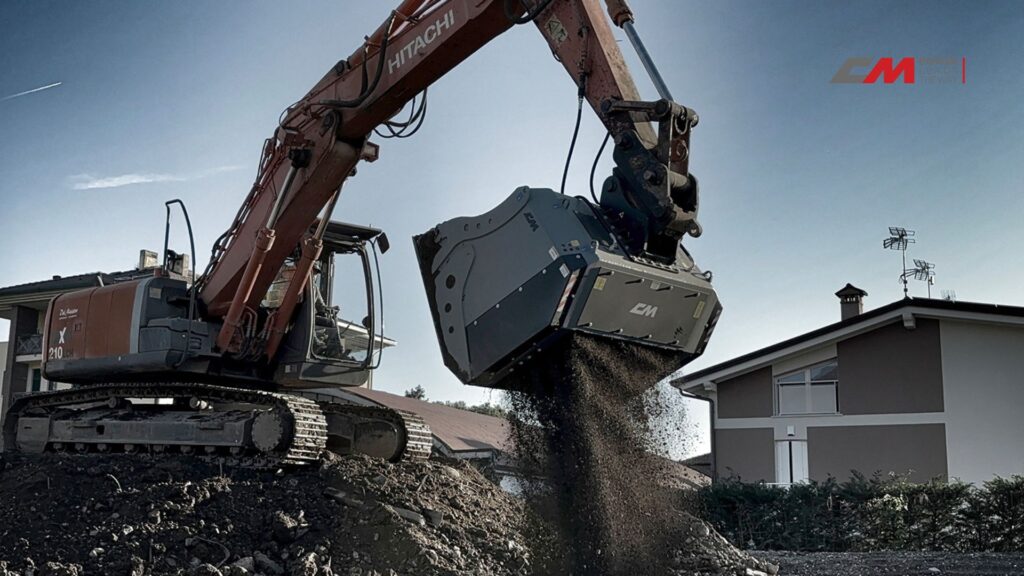
A traditional grading bucket for mini excavators or excavators and a screening bucket address the same basic need—material selection—but with a completely different approach. The grading bucket is a simple solution suitable for light, unstructured tasks. CBR and CDS screening buckets, on the other hand, are engineered to transform screening into an efficient, industrial, and controllable process.
The difference is clear not only in the working method but also in the quality and consistency of the results, as well as in terms of:
- Process control
- Productivity
- Operational reliability
- Adaptability to different materials
- Particle size uniformity
When a Grading Bucket Is No Longer Enough
There are situations where a simple grading bucket stops being an adequate tool and becomes an operational bottleneck. This happens when material selection is no longer a secondary operation but a core phase of the job. One of the first warning signs is declining productivity. As volumes increase or continuous operation is required, relying solely on excavator movement leads to longer processing times and inconsistent results. Screening quality varies depending on the operator and material conditions, making it difficult to maintain consistent standards.
Another limitation emerges when handling wet or heterogeneous materials. Damp, clayey, or mixed soils tend to compact between the bars, reducing efficiency and causing frequent work interruptions. Finally, grading buckets show their limits when a controlled and repeatable particle size is required. In these cases, visually separating material is not enough—an active process capable of ensuring uniformity, continuity, and control is essential.
In such contexts, a screening bucket like CBR or CDS represents a natural evolution, not just an alternative. Screening becomes an active, manageable process fully integrated into the site’s production cycle, delivering tangible benefits in terms of time savings, material quality, and overall performance.
Contact CM for Technical Advice
If you are evaluating a material selection solution and want to understand whether a CBR or CDS screening bucket is the best fit for your operational needs, read our dedicated article “Which Screening Bucket Should You Choose?” or contact us with no obligation. The CM Srl team is always available to provide dedicated technical consultation and help you identify the most effective attachment for your job site.
Frequently Asked Questions About Grading Buckets and Screening
No. A grading bucket and a screening bucket address the same basic need—material selection—but with very different levels of control and productivity. A grading bucket is suitable for simple and occasional tasks where rough separation is sufficient, while a screening bucket is designed for continuous use, uniform particle size, and controlled screening.
The main difference lies in the operating principle. A grading bucket is passive and relies solely on excavator movement, whereas a screening bucket works actively, powered by the excavator’s hydraulic system, which drives dedicated screening components to ensure more precise, consistent, and productive material selection.
You should consider a screening bucket when material selection becomes a central phase of the job, when processing volumes increase, when handling wet or complex materials, or when a uniform and repeatable particle size is required over time.