
 Products


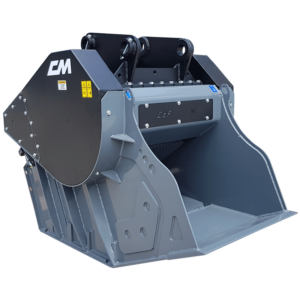


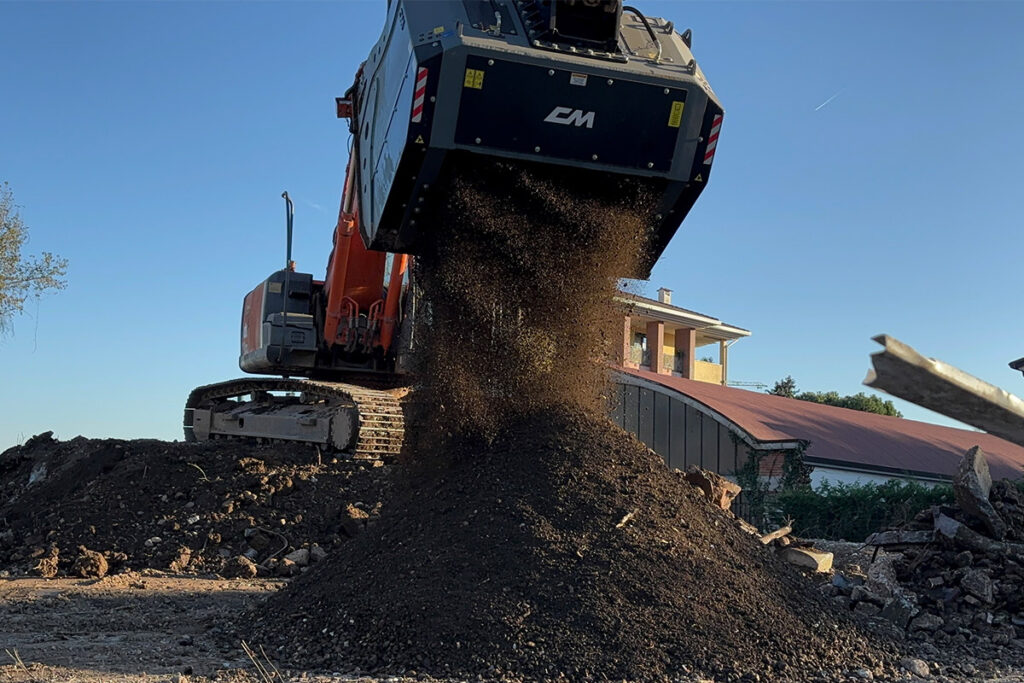
Earthmoving includes all the activities required to excavate, move, load, level, screen and compact soil, aggregates, rock, asphalt and materials from construction, roadwork or demolition sites. It is a very broad field, where what matters is not only the power and size of earthmoving machines, but also the ability to choose the most suitable attachment for the job to be carried out.
Excavators, skid steers, wheel loaders, backhoe loaders, telehandlers and other earthmoving equipment form the operational base of the job site. However, to increase productivity, reduce material handling and turn waste into reusable resources, they often need to be equipped with specific attachments. This is precisely where the solutions developed by CM Srl come into play, designed to make job sites more autonomous, versatile and well-organized.
What does earthmoving mean?
When we talk about earthmoving, we are not referring only to soil excavation. The term includes a set of operations connected to the preparation, transformation and management of materials on site. This includes excavation for foundations, trenches and underground utilities, loading and moving soil and rocks, preparing sub-bases, controlled demolition, crushing aggregates, screening materials, milling road surfaces and compacting after backfilling. For this reason, talking about earthmoving means considering a complete operating system: on one side there are the main machines, and on the other the attachments that allow specific operations to be carried out. An earthmoving machine, when properly equipped, can move from excavation to material screening, from crushing to area cleaning, right through to preparing the base for the next work phases.
The main earthmoving machines
Earthmoving machines are selected according to the type of operation, available space, material characteristics and required productivity. Every job site has different needs: an urban demolition project requires compact machines and precise attachments, while roadwork or quarry applications may require more powerful machinery capable of continuous operation.
Excavators and mini excavators
Excavators are among the most versatile earthmoving machines. They can be used for digging, demolition, loading, material handling, trenching and working in complex spaces. Thanks to the hydraulic arm and the possibility of mounting different attachments, they become extremely flexible machines. With dedicated equipment, an excavator can be transformed into a machine for crushing aggregates, screening soil and demolition material, milling asphalt or concrete surfaces, compacting sub-bases and handling blocks or construction waste. For this reason, in modern operations, the value of an excavator depends not only on the machine itself, but also on the quality of the attachments fitted to it.
Wheel loaders, skid steers and backhoe loaders
Wheel loaders, skid steers and backhoe loaders are earthmoving machinery mainly used to load, move and distribute material. They are widely used on roadwork sites, in industrial areas, municipal works, urban development projects and wherever bulk material needs to be moved quickly. These machines can be equipped with sweeper buckets, mixing buckets, screening buckets, angle sweepers and surface-cleaning attachments. In this way, a single machine can perform several work phases, reducing the need to use different machines for each individual operation.
Compactors and vibratory plates
After excavation and backfilling, base compaction is an essential phase. Soil that is not properly compacted can cause subsidence, depressions, instability of the laying surface and later issues with paving, underground utilities or roadworks. Excavator-mounted vibratory plates make it possible to compact the material directly with the machine already on site, even in areas that are difficult to reach with rollers or traditional compactors. The CM PV vibratory plate, for example, is designed to compact bases after excavation and can also be used as a pile driver.
The most important operations in earthmoving
Excavation, trenches and micro-trenches
Excavation is one of the core activities in earthmoving. It may involve foundations, channels, underground utilities, pipe laying, electrical networks, fibre optic cables or urban development works. In these cases, it is essential to obtain a clean cut, with controlled depth and a section suitable for the type of intervention. For more specific operations, such as mini-trenches and micro-trenches, CM Srl offers wheel trenchers designed to work on hard and compact surfaces. The T and TM series are designed for skid steer applications, with the aim of creating small excavations and trenches in asphalt, rock and concrete.
Crushing aggregates directly on site
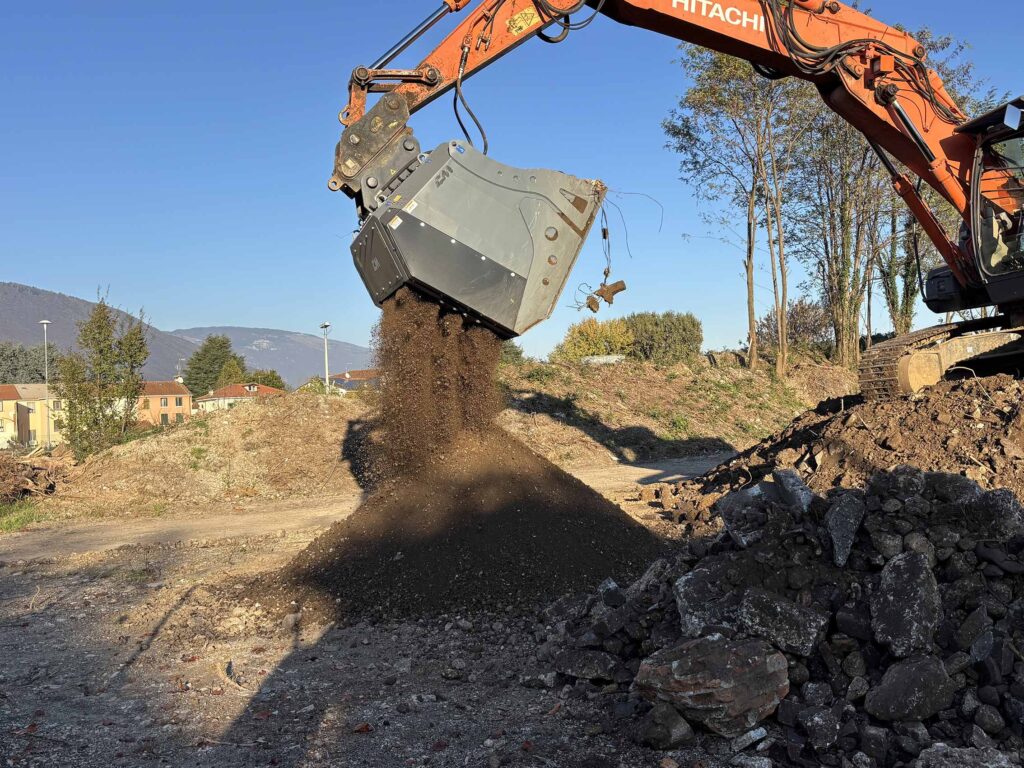
Demolition sites, excavation works and road projects often generate inert materials such as concrete, bricks, stones, rock and mixed residues. Transporting them away from the job site involves transport costs, handling time and disposal expenses. This is why on-site crushing is becoming an increasingly strategic solution. Crusher buckets make it possible to reduce material directly on site, turning waste into reusable aggregates for sub-bases, backfills, job site tracks or further processing. The CBF crusher bucket is designed for crushing inert material directly on site and is suitable for working even in difficult conditions. For more compact machines, the CBF-L crusher bucket allows output size adjustment from 10 to 80 mm. For stationary applications or production environments, the CR electric jaw crusher is a useful solution for recycling concrete and inert material from small demolitions, excavations or production waste.
Screening and material selection
Screening makes it possible to separate material according to size, distinguishing soil, stones, aggregates, fine material and reusable fractions. It is a fundamental phase when the goal is to recover material already present on site, improve aggregate quality or prepare the ground for subsequent operations. CM screening buckets are designed to work directly with excavators, loaders, backhoe loaders and skid steers. The CBR screening bucket uses a basket with interchangeable bolted grids and is suitable for screening materials such as riverbed material, stony soil and demolition aggregates. The CDS disc screening bucket, on the other hand, is particularly useful when the material is wet, mixed, abrasive or difficult to process.
Road milling and surface maintenance
In the roadwork sector, earthmoving often overlaps with the removal of asphalt, concrete, surface layers, damaged sections and industrial paving. In these cases, attachments are needed that can work with precision, maintaining constant depth and good visibility for the operator. CM road milling attachments meet this requirement. The FS series can be mounted on skid steers, backhoe loaders and hydrostatic wheel loaders, while the FSE series is designed for excavator arms and can also work on vertical surfaces, bridge piers, walls and areas that are difficult to reach.
Handling and management of solid materials
Handling solid materials is another recurring phase on job sites. Blocks, stones, construction waste, bulky waste, branches and irregular materials require grip, control and stability. Earthmoving machines become more effective when equipped with attachments capable of gripping, sorting and moving material safely. The G series sorting grapple is designed for the selection and handling of solid material and, thanks to continuous 360° hydraulic rotation, allows loads and unusual shapes to be managed more easily.
Why the right attachment matters as much as the machine
In everyday language, job sites are often associated with large earthmoving machines: excavators, loaders, backhoe loaders, skid steers and tracked machines. In reality, productivity also depends heavily on the attachment installed on the machine. The right attachment reduces work steps, limits material transport, speeds up operations and increases job site autonomy.
A crusher bucket can turn an excavator into a machine for aggregate recovery. A screening bucket makes it possible to separate material directly on site. A road milling attachment allows work on asphalt and concrete without the need for large dedicated machines. A vibratory plate makes it possible to compact the base using the same excavator already used for excavation. This approach is particularly important on job sites where space is limited, time is tight or material must be recovered without constant external transport. Choosing the right attachment therefore becomes an integral part of work planning.
The cleaning phase also plays an important role on site. CM sweepers make it possible to clean road surfaces, yards and indoor or outdoor paving. Depending on the requirements, it is possible to choose models with collection bucket, reinforced HD versions, angle sweepers or solutions for municipal and industrial applications. When the job site requires concrete preparation directly on site, a mixing bucket allows concrete to be produced quickly and practically. The MIX mixing bucket is designed to produce concrete in different operating conditions, with models suitable for a range of needs.
How to choose earthmoving machines and attachments
The choice of earthmoving equipment and attachments depends on several factors. There is no single solution suitable for every job site, because every operation involves different materials, spaces, timeframes and objectives. Before choosing an attachment, it is important to assess:
- the type of material to be processed: soil, rock, asphalt, concrete, brick, mixed aggregates, branches or construction waste;
- the machine available: excavator, skid steer, wheel loader, backhoe loader, telehandler or municipal operating machine;
- tonnage and hydraulic system, especially the flow rate and pressure required by the attachment;
- the final result: excavation, crushing, screening, milling, compaction, mixing or cleaning;
- the operating space, especially on urban, roadwork or indoor job sites;
- material management, meaning whether the material must be disposed of, reused or transformed into a new resource.
A common mistake is to consider only the size of the machine. In reality, the correct combination of earthmoving machine and attachment makes it possible to achieve more balanced performance, lower operating consumption and better organization of the work phases.
CM solutions for a more autonomous job site
CM Srl develops attachments for earthmoving machines designed to increase the versatility of the equipment already available on site. The goal is to allow companies to perform more operations with fewer steps, reducing time, unnecessary handling and dependence on external plants.
The range includes solutions for crushing, screening, material handling, road milling, compaction, surface cleaning, trenching and concrete mixing. In this way, excavators, loaders, backhoe loaders, skid steers and telehandlers can become complete operating systems, capable of adapting to the different phases of the job. In modern earthmoving, the difference is not made only by machine power, but by the ability to organize the job site more efficiently. Excavating, screening, crushing, reusing, compacting and cleaning directly on site means working with greater control, reducing time and making better use of available resources.
Do you want to choose the most suitable attachment for your job site?
Every job site requires a specific assessment based on the type of material, the available machine and the result to be achieved. To identify the most suitable solution among crusher buckets, screening buckets, road milling attachments, vibratory plates, grapples, sweepers and mixing buckets, contact CM Srl: the team can help you configure the right attachment to make your work more efficient and productive.
Frequently asked questions about earthmoving
Earthmoving includes excavation, loading, moving, levelling, screening and compacting soil, aggregates, rock, asphalt and job site materials.
The main earthmoving machines are excavators, mini excavators, wheel loaders, skid steers, backhoe loaders, dumpers, rollers and compactors.
The machine is the base equipment used on site. The attachment is the tool mounted on the machine to perform specific operations, such as crushing, screening, milling, compaction or material handling.
Yes. With crusher buckets and screening buckets, it is possible to crush, select and reuse part of the materials produced by excavations and demolitions, reducing transport and disposal.
You need to assess the type of material, available space, operation to be carried out, machine tonnage, hydraulic flow rate and required final result.